
How Shelby Van Pelt Hid a Mystery Inside a Literary Novel
Part 6 of Beyond the Octopus: A Remarkably Bright Creatures Masterclass
Here's something most readers don't consciously register while reading Remarkably Bright Creatures: it's a mystery novel.
Not in the way Agatha Christie is a mystery novel.
Not even in the way Gone Girl is a mystery novel.
But structurally, architecturally, at the level of plot mechanics, there is a question on page one that the entire book exists to answer.
What happened to Erik Sullivan?
That question is what keeps a quiet, character-driven grief novel from becoming a meditation. It's the engine underneath the engine. And understanding how Van Pelt built it — how she hid a mystery inside a literary novel without either element undermining the other — is one of the most instructive craft lessons this book has to offer.
The mystery isn't decorating the literary novel. It's holding it up.
→ Catch up on the whole story in Why Remarkably Bright Creatures Became a Bestselling Debut Novel (It Wasn't the Octopus).

The Question Established on Page One
Van Pelt doesn't waste time. Within the opening pages, we know that Tova Sullivan has spent thirty years not knowing what happened to her son. He went out on a boat one night at eighteen and never came back. His boat washed ashore. The authorities ruled it probable suicide. No body was ever found.

That last detail is doing enormous structural work.
Why? Because "no body was ever found" is not a grief fact. It's a mystery fact. It's the open door the reader's brain immediately walks through. The question isn't just what happened to Erik. It's whether the official story is even true. And Tova's quiet, thirty-year refusal to accept the suicide ruling tells us she's been asking the same question the whole time.
Van Pelt plants the mystery in the grief. The two are inseparable from the first pages.
This is the structural move worth studying. She doesn't set up the mystery separately from the emotional core. She builds it into the emotional core.
Tova's grief is unresolved precisely because the mystery is unresolved. One cannot be answered without the other.
Three POVs, One Question
The architecture of Remarkably Bright Creatures is more complex than it appears on first read.
We have Tova — grieving, aging, working the night shift, waiting without knowing she's waiting.
We have Cameron — directionless, searching for his biological father, heading toward Sowell Bay for reasons he doesn't fully understand.
And we have Marcellus — observing both of them, knowing things neither of them knows, moving toward an action that will change everything.

Each of these threads is pulling toward the same answer. And the reader feels the convergence before any of the characters do.
In a genre mystery, the detective would be actively investigating. Here, nobody is actively investigating.
Tova has accepted not knowing. Cameron doesn't even know what he's looking for. Marcellus knows everything and can't speak.
Van Pelt builds the mystery without a detective. The investigation happens through character movement rather than deliberate inquiry.
This is a more sophisticated mystery structure than most genre fiction uses, and it's perfectly suited to literary fiction.
The question gets answered not because someone set out to answer it, but because life, grief, and an extremely intelligent octopus conspired to bring the right people into the same room.
The Structural Tension Worth Acknowledging
Here's an honest observation: most readers figure out that Cameron is Erik's son well before Tova or Cameron do.
The clues are there — the last name, the timing, the photo of Cameron's mother with an unknown man. Careful readers assemble them faster than the characters.
And here's the thing: that's not a flaw. That's the point.
The tension doesn't disappear when you solve the puzzle. It transforms.

Once you know, the question shifts. Not "what happened to Erik?" but "will they figure it out — and how?"
You're watching two people move toward a truth you're already holding, and you're watching an octopus try to solve a human problem with no opposable thumbs and a rapidly closing window of time.
Because Marcellus is dying. And he knows. And he tries to plant Cameron’s driver's license under a sea lion statue, and they still they don't see it.
That's not whodunit tension. That's "please, someone, figure this out before it's too late" tension.
Van Pelt made a choice: she prioritized emotional impact over puzzle satisfaction.
The mystery is the setup. The dramatic irony is the actual engine.
For this book, with this audience, that was exactly right.
The Simon Brinks Red Herring
One structural element that often gets overlooked is Simon Brinks.
Cameron arrives in Sowell Bay convinced that Simon Brinks, a wealthy local property developer, is his biological father.
But he's wrong. Simon was simply an old friend of Daphne's. He has nothing to do with Cameron's parentage.

That misdirection is doing classic mystery work. It sends Cameron, and a subset of readers, down a dead end that has to collapse before the real answer can emerge. The dead end isn't wasted space.
It forces Cameron to finally stop running, stop chasing the wrong answer, and face what's actually in front of him.
The red herring serves the character arc.
Cameron needed to exhaust the wrong answer before he could receive the right one. The mystery structure and the character's internal resistance are solving the same problem at the same time. That's elegant. That's the work.
What Marcellus Provides That No Human Character Could
In a traditional mystery, the detective assembles the clues and delivers the revelation.
In Remarkably Bright Creatures, the detective is an octopus. (Which, when you say it like that, sounds absurd. But it’s so much fun!)
No human character in the book could credibly deliver the revelation without it feeling contrived.
Tova doesn't have the information. Cameron doesn't know what he's looking for. The secondary characters who might know pieces of the truth don't have the full picture.
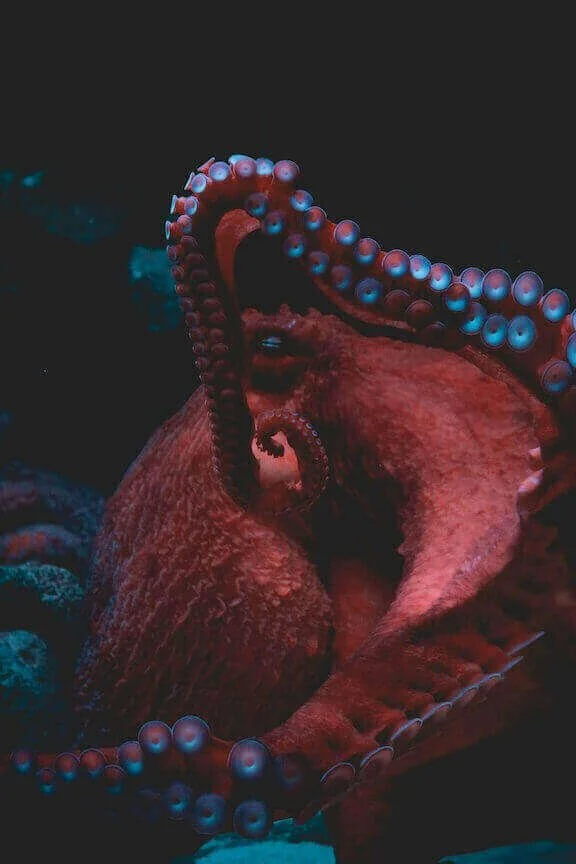
Marcellus has observed everything. He knows. And he tries.
First, the driver's license. He retrieves Cameron's ID and places it where Tova will find it — a small, impossible act of intelligence that should connect the dots.
It doesn't.
Marcellus, watching from his tank, has done something extraordinary and the humans have walked right past the answer.
So he tries again.
His final act — retrieving the class ring engraved EELS (Erik Ernest Lindgren Sullivan) and placing it where Tova will find it — is what finally breaks the case open.
The ring connects Cameron to Erik, reveals that Cameron is Tova's grandson, and gives Tova the closure she has waited thirty years to receive.
The first attempt failing matters. It's not padding. It establishes that Marcellus is working against real constraints — the limits of what an octopus can communicate to a human who isn't looking for what he's trying to show her.
The second attempt succeeding feels earned precisely because the first one didn't.
The octopus is the detective. The whimsy is the solution. And it works because Van Pelt built toward it from page one.
→ We look at how Van Pelt made that whimsy work without breaking the emotional register in How Shelby Van Pelt Made Remarkably Bright Creatures Funny AND Devastating. (coming soon!)

What This Means for Your Writing
The lesson here isn't "hide a mystery in your literary novel."
The lesson is that propulsive structure and emotional depth are not opposing forces.
We sometimes write as if we have to choose — either plot or character, either page-turning momentum or literary seriousness. Remarkably Bright Creatures is evidence that the choice is false.

A question established on page one and answered on the final pages is not a genre concession. It's a structural gift to the reader.
It gives them something to hold while they do the harder work of sitting with a character's grief, watching a young man find his way, learning to see the world through the eyes of a dying octopus.
Give your reader something to pull them forward. The emotional work happens in the space that propulsion creates.
The mystery in Remarkably Bright Creatures isn't a thriller mechanism. It's a promise. Van Pelt makes it on page one and keeps it on the last page, and in between she fills the space with everything that actually matters.
That's the whole architecture. And it's worth learning from.
Want a debut as successful as Remarkably Bright Creatures?
A great brand, like a great novel, makes a promise on the first page and keeps it throughout. If you're not sure what promise your author brand is making, here’s a free guide to create the type of brand agents and publishers go to auction over.

If You Liked This Article, You’ll Also Love…
The Magic of Subtle Worldbuilding: Why Less is More in Magical Realism
Multiple POV Done Right: Storytelling Techniques from Wild Dark Shore
Mastering Atmosphere: Writing Lessons from Robert Louis Stevenson's "The Body Snatcher"
Why Authors Should Study Folklore: 7 Lessons from Cat's Tales
How to Use Animal Symbolism in Your Fiction (5 Proven Techniques)
