
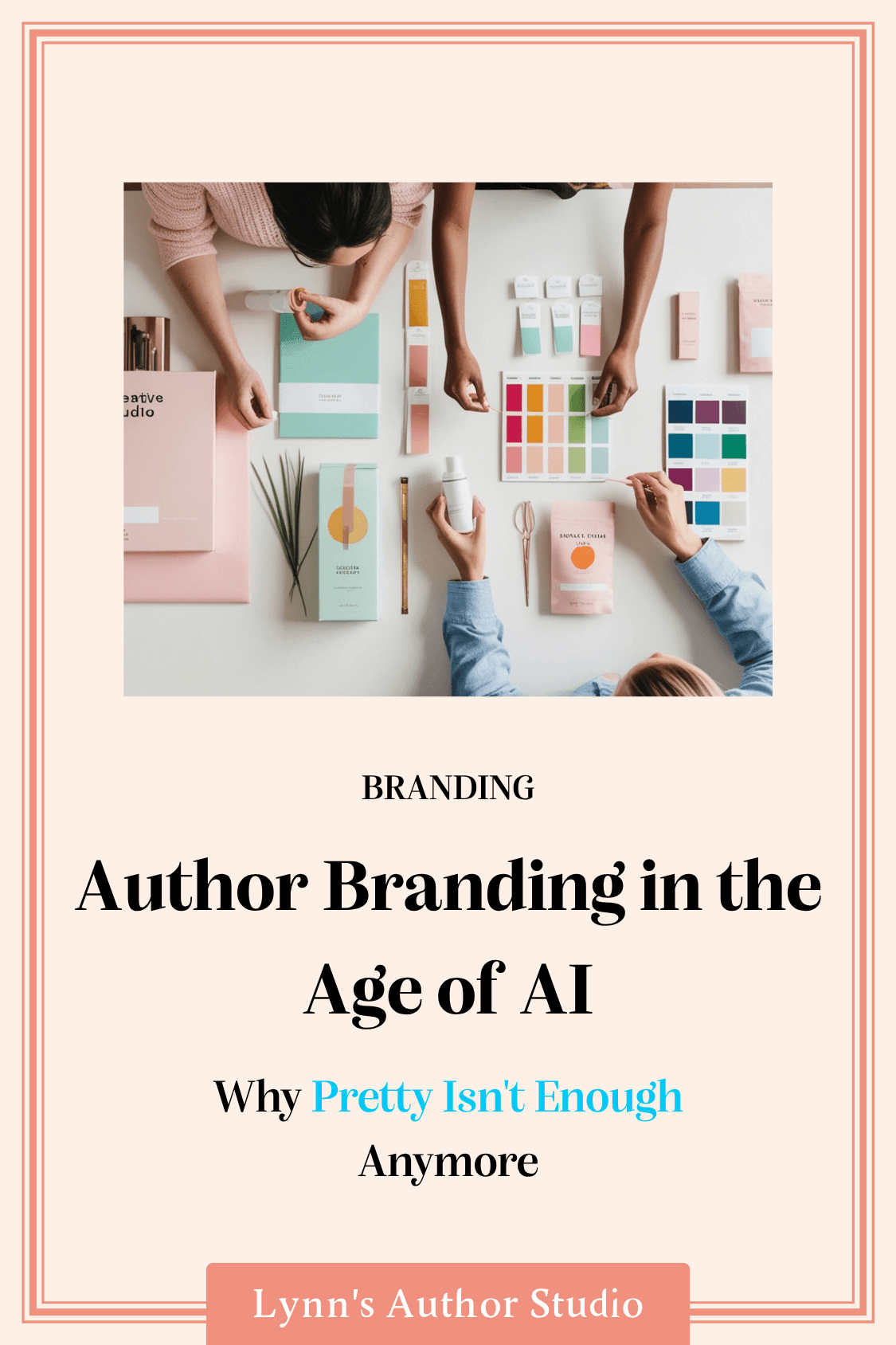
Part 1 of Unmistakably Human: Author Branding in the Age of AI
It used to be that a pretty website put you ahead of most authors.
Ahead of the clunky sites that hadn't been touched since 2014.
Ahead of the free templates with one lonely book cover floating in a sea of white.
If you invested in something clean, beautiful, and professional, people noticed. You looked serious because most authors didn't bother.

But now AI can plagiarize pretty.
Which means pretty is no longer enough to stand out, or to connect with the readers you're writing for.
This changes what author branding in the age of AI has to do. The question used to be "Does my website look nice?" Now it's "Does my website unequivocally look and feel like me and my novels?" And unfortunately, “Does my website stand out in the age of AI?”
So let's talk about why this shift matters, and the six things we can do about it.
Why Pretty Isn't Enough Anymore
A polished website used to be a signal. It said: this author is invested. This author takes her career seriously. This author is ready.
But signals only work when they're hard to fake.
AI tools can now plagiarize a polished website design. Which means the signal that once set you apart is available to everyone, for free, in an afternoon.
And when everyone has polish, polish stops meaning anything.
But here's what nobody tells you: that's good news for real authors.
Because readers, agents, and editors didn't fall in love with pretty. They fell in love with the person it pointed to.
Researchers have found that when people believe an emotional message was written by AI, they see it as less authentic and feel less loyal to whoever sent it. Readers can feel the difference between a person and a performance. We all can.
But the one thing AI can't copy is you.
Your book cover can no longer be the only thing on your homepage. A cover tells readers what you wrote. Your brand tells them who wrote it, and why they should care about the next book too.
So what does an unmistakably human author brand actually look like? Here are the six places to start.
1. Start With Your Author DNA, Not a Template Bio

Your author bio travels further than almost anything else you write.
It's in your query letter. It's on your Amazon page, your book jacket, and every event program you'll ever appear in. And when someone asks a search engine or an AI tool who you are, your bio is often what comes back.
Which is why it's such a problem that most of them sound the same.
Try it out. Read ten author bios in a row and you'll notice something strange.
Everyone is a lifelong reader. Everyone lives with a spouse, two kids, and a very opinionated cat. Everyone writes "stories that stay with you." Why?
Because bios have always leaned on formula, and then AI made the formula instant.
When we ask a tool to write our bio, it gives us the most statistically likely bio, which is to say, everyone else's.
To stand out, your bio should be written in a way that only describes you.
That's where your Author DNA comes in (the essence I build all my client brands and websites around).
Your Author DNA is the through-line across everything you write: the questions you can't stop asking, the emotional territory you keep returning to, the thing readers feel before they've read a word. It's why your brand can grow with your career instead of expiring with your first book.
When your bio comes from your Author DNA, it stops sounding like a category and starts sounding like a person.
Try this today: Read your current bio and circle every phrase that could appear, word for word, in another author's bio. Whatever's left is where your real bio begins.
→ See before-and-after bio examples in Why Your Author Bio Matters More Than Ever in the Age of AI. (coming soon!)
2. Run the Swap Test on Your Website
"What should I put on my author website?" is one of the first questions every author asks.
And most advice on making your author website stops at a generic checklist: a homepage, your books, info about you, a way to contact you, and a newsletter signup.
And yes, you need those. But in the age of AI, every author can check every box in an afternoon. And a checklist only tells you what to include. It can't tell you whether any of it sounds like you.
Most advice on making your author website stand out stops at the checklist: a homepage, your books, an about page, a way to contact you, and a newsletter signup.
That's what the swap test is for.

Take any element on your website, a photo, a tagline, a paragraph, and ask one question: If I swapped in another author's name, would anything break?
A stock photo of a latte beside an open book passes for anyone. So does "Welcome to my corner of the internet." Nothing breaks when you swap the name, which means nothing there is doing the work of telling readers who you are.
Now picture a photo of the actual shelf of research books behind your novel. Or a tagline only your stories could earn. Swap the name on those and the whole thing falls apart.
That's the goal. Every element should tell a reader something so true about you that no one else could steal it.
Try this today: Run the swap test on your homepage's top section, the first thing visitors see. If any author could use the same text and images, that's your first fix.
→ Apply the swap test page by page in How to Make Your Author Website Stand Out in the Age of AI. (coming soon!)
3. Take Control of Your Narrative
Right now, someone is forming an impression of you.
An agent googling you after your query lands in her inbox. A reader who finished your book at 2 a.m. and wants to know who wrote it. And increasingly, an AI tool answering a question like "What should I read if I loved this book?" or "Who is this author?"
All of them are assembling a story about you from whatever they can find. And if you haven't given them a clear source, they'll build it from scraps: an outdated Goodreads profile, a stray interview, a social media post from four years ago.
With a website that’s pulling its weight, you get to be the primary source of your own story.
That's what your website should be: the one place online you fully control. Where you decide what's true, what's current, and what matters most.
Think of it as claiming authorship of your own career, the same way we claim authorship of our books.
Try this today: Open a private browser window and search your name. Then ask an AI chatbot, "Who is [your name], the author?" Write down what comes back. That's the story the internet is currently telling about you.
→ Learn how to rewrite that story in Your Author Online Presence: How to Own Your Story in the Age of AI. (coming soon!)
4. Let Readers Get to Know You With an Author Q&A
Readers are hungry to connect with the person behind the books.
And a Q&A section is one of the most natural ways to let them.
It's conversational by nature, which means it's written in your voice instead of your “marketing voice.” Readers get to hear how you actually talk, what you find funny, and what you care about.
But the questions matter more than the answers.
"Where do you get your ideas?" and "What's your writing routine?" are the questions every author answers. And your answers will probably sound like everyone else's, because the questions are built that way.
The questions that build connection are the ones only you could answer.
What did you cut from the book that you still miss? Which scene did you rewrite eleven times? What's the strangest thing in your search history because of this story?
A great Q&A lets readers meet you before they meet your book.
And once they've met you, they're far more likely to want the book.
Try this today: Imagine a reader who loved your book is sitting across from you at a coffee shop. Write down five questions they'd ask you. Not an interviewer. A reader.
→ Find the questions readers actually want answered in 17 Author Q&A Questions Readers Actually Want Answered. (coming soon!)
5. Share Your Process
AI can produce a finished page in seconds. What it can't produce is your process.
The marked-up draft. The notebook with coffee rings on the cover. The index cards taped to the wall at midnight. The playlist you wrote the climax to on repeat.
Every one of these is part of a story readers almost never get to see: how the book came to be.
Your process is the story before the story.
When readers watch a book come together, they become invested in it. They were there for the rewrites and the doubts. And by launch day, it's partly their win too.
And if your book isn't out yet, this matters even more. You don't have a book to show. You have the making of one, and that's some of the most interesting content you'll ever have.

This is where candid photos shine. Not the posed, perfectly lit author portrait (though keep that too), but the real ones.
Your desk mid-draft. Your hand holding a printed chapter covered in red ink. The view from wherever you actually write.
The best candid photos carry information. They tell readers something specific about how you work and who you are.
A photo that could belong to any writer is just decoration. A photo that could only be yours is an invitation in.
Sharing your process also puts readers inside the journey instead of outside the finished product. And we authors know better than anyone that the journey is where the real story is.
Try this today: The next time you sit down to write, take one photo of your workspace before you tidy it. That's the start of your process archive.
→ See how to share it (and what to keep private) in Why Sharing Your Author Writing Process Builds Readers in the Age of AI. (coming soon!)
6. Consider Signaling It: Human Authored Certification
Most authors haven't heard of this yet, and it's worth knowing about.
In the US, the Authors Guild created a Human Authored certification. Authors confirm their book was written by a human, register it in a public database, and can display an official logo. It opened to members in early 2025 and expanded to all authors with books published in the US in March 2026.
In the UK, the Society of Authors launched its own Human Authored scheme in March 2026, created in partnership with the Authors Guild.
So should you use it?
Here's where we hold more than one truth at once. For some authors, a clear label is a meaningful way to tell readers exactly where they stand.
Others point out that a logo verifies who the author is rather than proving how the book was written, and they'd rather let their work and presence speak for themselves.
A label can support a human brand, but it can't replace one.
The logo tells readers a human wrote the book. But everything else on the above list tells them which human.
Try this today: Ask yourself whether a Human Authored label would feel like an honest expression of who you are, or like a badge you're wearing because you feel you should. There's no wrong answer, only yours.
→ Compare the US and UK schemes in Human Authored Certification: What Is It and Is It Worth It? (coming soon!)
Pretty Got Cheap. You Didn't.
I've sent over 300 queries, so I know what it's like to wonder whether anyone on the other side of the inbox will ever see you, not just the first line of your query letter.
That's the same fear sitting underneath all of this AI noise. The fear that us authors will disappear into a flood of artificially generated content.
But we won't. Not if we stop hiding behind “pretty” and start showing up fully (maybe even a little aggressively) as ourselves.
AI can copy a layout. But it can't copy your reasons, your obsessions, your process, or the way you see the world.
That's your author brand. That's what makes readers stay.
Your website just has to share that with the world.
Ready for a website that could only be yours?
You've seen why pretty isn't enough anymore. Let's build an author brand and website around who you actually are, so potential readers can meet and fall in love with you.
If You Liked This Article, You’ll Also Love…
What Tamora Pierce's 30-Year Career Teaches Us About Author Brand Evolution
Why Author Branding Isn't Vanity—It's Survival: Professional Design in the Age of Digital Censorship
What Tom Felton's Beyond the Wand Teaches About Author Vulnerability
Building Your Author Brand Like Charlotte McConaghy: From YA to Literary Thriller
