
How Shelby Van Pelt Made Remarkably Bright Creatures Funny AND Devastating

Part 7 of Beyond the Octopus: A Remarkably Bright Creatures Masterclass
There is a moment near the end of Remarkably Bright Creatures where Marcellus, a giant Pacific octopus who has spent the novel observing humanity from behind glass with barely concealed exasperation, delivers his final verdict on the species.

"Humans. For the most part, you are dull and blundering. But occasionally, you can be remarkably bright creatures."
It's funny. It's the title drop.
And somehow, in the context of everything that has happened — Tova's thirty years of grief, Marcellus's own approaching death, the family that almost didn't find each other — it's also completely devastating.
That's the trick. And it is a trick, in the best possible sense.
Van Pelt pulls it off on almost every page of this book, and understanding how she does it is one of the most transferable craft lessons in the entire cluster.
Whimsy and grief are not opposites in this novel. They are in constant, deliberate conversation.
→ Catch up on the whole story in Why Remarkably Bright Creatures Became a Bestselling Debut Novel (It Wasn't the Octopus).

What Earned Whimsy Actually Means
Let's be precise about what we mean when we say this book is funny.
It's not sitcom funny. It's not cozy-mystery funny, where everything is a little twee and nothing actually hurts. I
t's the particular kind of funny that happens when a very intelligent, very dry voice observes human behavior from outside it — and the observations are both accurate and absurd.

Marcellus on jokes: "Humans are the only species who subvert truth for their own entertainment. They call them jokes. Sometimes puns."
Marcellus on his own intelligence: "My neurons number half a billion, and they are distributed among my eight arms. On occasion, I have wondered whether I might have more intelligence in a single tentacle than a human does in its entire skull."
Marcellus on his timeline: "I must resubmerge within eighteen minutes or I will experience The Consequences."
(The Consequences — I LOVED this concept.)
This is dry wit operating at a very high level. The humor comes from specificity, from the gap between how Marcellus talks about things and how the humans around him experience them.
It never winks at you. It never announces itself as a joke. It just lands, and then moves on.
That's what earned whimsy looks like. It doesn't pause for applause. It trusts you to catch it.
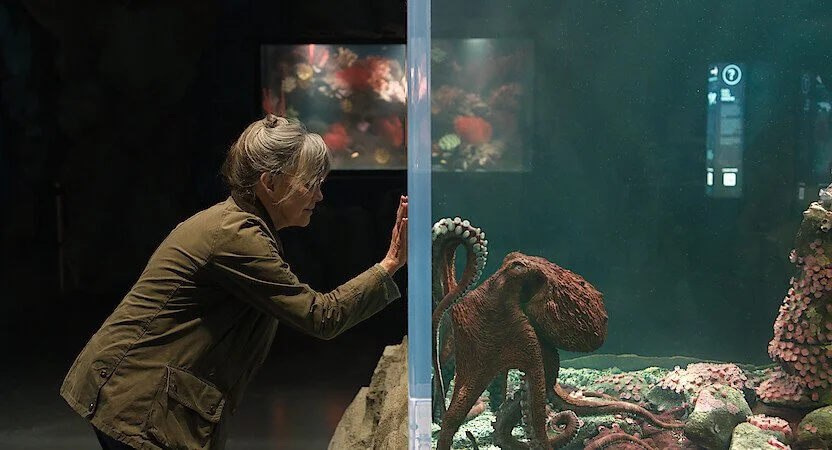
Why the Grief Makes the Humor Land Harder
Here's the counterintuitive truth about tonal balance in this novel: the humor doesn't lighten the grief.
The grief makes the humor hit harder.
Why? Because we know what Marcellus is observing when he watches Tova move through the aquarium at night. We know the weight she's carrying. We've been inside her chapters.
So when Marcellus notes, with his particular brand of affectionate bewilderment, that she is cleaning the same tank for the third time tonight, we feel both the comedy of his observation and the heartbreak of what it reveals.
She cleans things obsessively. Because keeping moving is how she survives. Because stopping means sitting with the grief.
Marcellus doesn't editorialize. He observes. And we supply the emotion ourselves, because we've been given everything we need to do so.
This is one of the most sophisticated things Van Pelt does: she lets the tonal contrast do emotional work that explicit description couldn't.
A passage that told us directly how sad Tova is would be less devastating than a passage where Marcellus notes, drily, that the cleaning lady appears to have rearranged the same display for the fourth time.
We know why. He doesn't say it. The gap between what he sees and what we understand is where the heartbreak lives.
The Structural Role of the Humor
We touched on this in the grief post, but it's worth unpacking here from a craft angle.
Tova's chapters are emotionally demanding.
They ask the reader to sit with thirty years of unresolved loss, with the quiet devastation of a woman who has organized her entire life around not falling apart. That's a lot to carry for an extended stretch of reading.

Marcellus's chapters are the exhale.
Not because they're lightweight — they're not, especially as his own mortality becomes more present in the narrative.
But his voice, his dry observations, his particular brand of octopus-flavored commentary on the humans around him, all of it gives the reader just enough relief to go back into Tova's interior world and feel it more completely.
Van Pelt spaces the chapters deliberately. The rhythm of Tova-Cameron-Marcellus creates a kind of emotional breathing pattern across the book.
Tova: inhale.
Cameron: hold.
Marcellus: exhale.
Then back in.
The whimsy is structural. It's not sprinkled in for flavor — it's load-bearing.
Remove Marcellus's humor and the book becomes too heavy. Keep it, and the reader can stay inside the grief long enough for it to do its work.
The Tonal Rule Worth Stealing
Here's what I keep coming back to when I think about how Van Pelt manages this.
She never lets the humor comment on the grief.
Marcellus observes Tova. He cares for Tova. But he doesn't stand outside her pain and make jokes about it. The humor and the grief occupy the same space without ever directly addressing each other.
The maple syrup passage is a perfect example. Tova reflects that once your soul is soaked through with grief, any more simply runs off — the way maple syrup on Saturday morning pancakes always cascaded onto the table whenever Erik was allowed to pour it himself.

It's grief rendered through a specific, domestic, completely mundane memory. A small boy pouring too much maple syrup.
And somehow that image — that tiny, ordinary Saturday morning — lands harder than any dramatic declaration of loss could.
Grief, in Van Pelt's hands, lives in the specific. The humor lives in the specific too.
That's why they can coexist without canceling each other out.
Both are drawn from the same well: precise, accurate observation of what it actually feels like to be alive.
Funny and devastating are just two different ways of being exactly true.
What This Means for Your Writing
Tonal balance is one of those things that's easy to understand and genuinely hard to execute. We talk about it in workshops and craft books as if it's a dial you can turn. It isn't.
It's more like two instruments playing at once — they either harmonize or they don't, and the difference is almost entirely a matter of specificity.

Generic humor cancels out grief. Generic grief cancels out humor. Both feel performed, which is death for either.
But specific humor — the kind that comes from a particular voice observing a particular truth — can coexist with specific grief because both are operating at the same level of truthfulness.
They're not fighting each other. They're describing the same thing from different angles.
Van Pelt earns the tonal balance by being precise. About Marcellus's voice. About Tova's memories. About the maple syrup on the Saturday morning pancakes.
You don't balance tone by moderating it. You balance it by being equally specific about both the light and the dark.
→ We explore what Marcellus himself teaches about non-human narrators in Marcellus the Octopus: 5 Lessons About Writing Unforgettable Narrators.(coming soon!)

Wondering how your author brand's emotional register shows up on the page?
Tone isn't just about words. The fonts on your website are sending a signal before anyone reads a single sentence. If you're not sure what yours is saying, start here.

If You Liked This Article, You’ll Also Love…
The Magic of Subtle Worldbuilding: Why Less is More in Magical Realism
Multiple POV Done Right: Storytelling Techniques from Wild Dark Shore
Mastering Atmosphere: Writing Lessons from Robert Louis Stevenson's "The Body Snatcher"
Why Authors Should Study Folklore: 7 Lessons from Cat's Tales
How to Use Animal Symbolism in Your Fiction (5 Proven Techniques)
