
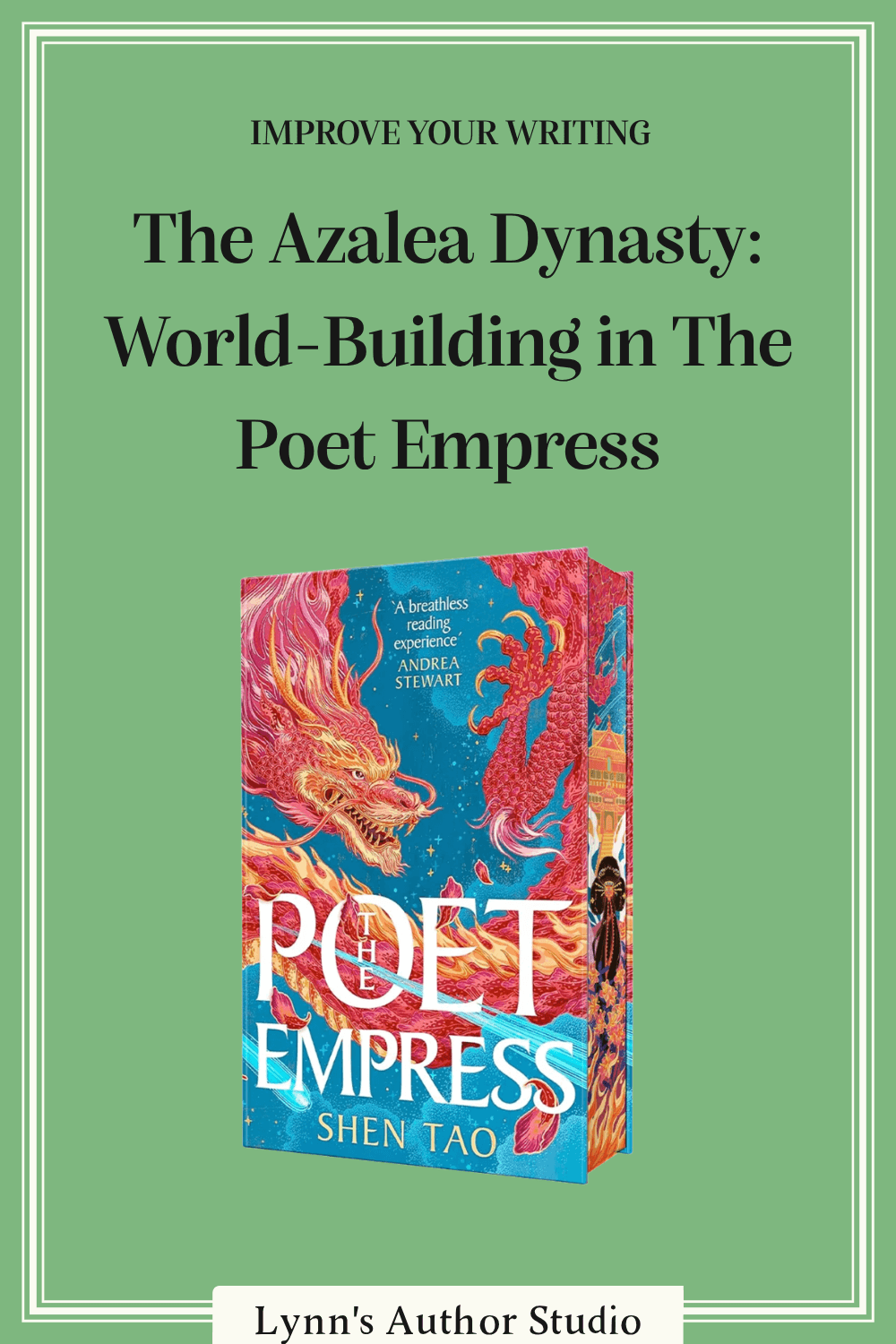
Part 3 of Poetry & Power: A Master Class with Shen Tao
Most fantasy empires get an entire trilogy to unfold. Shen Tao gave hers one book.
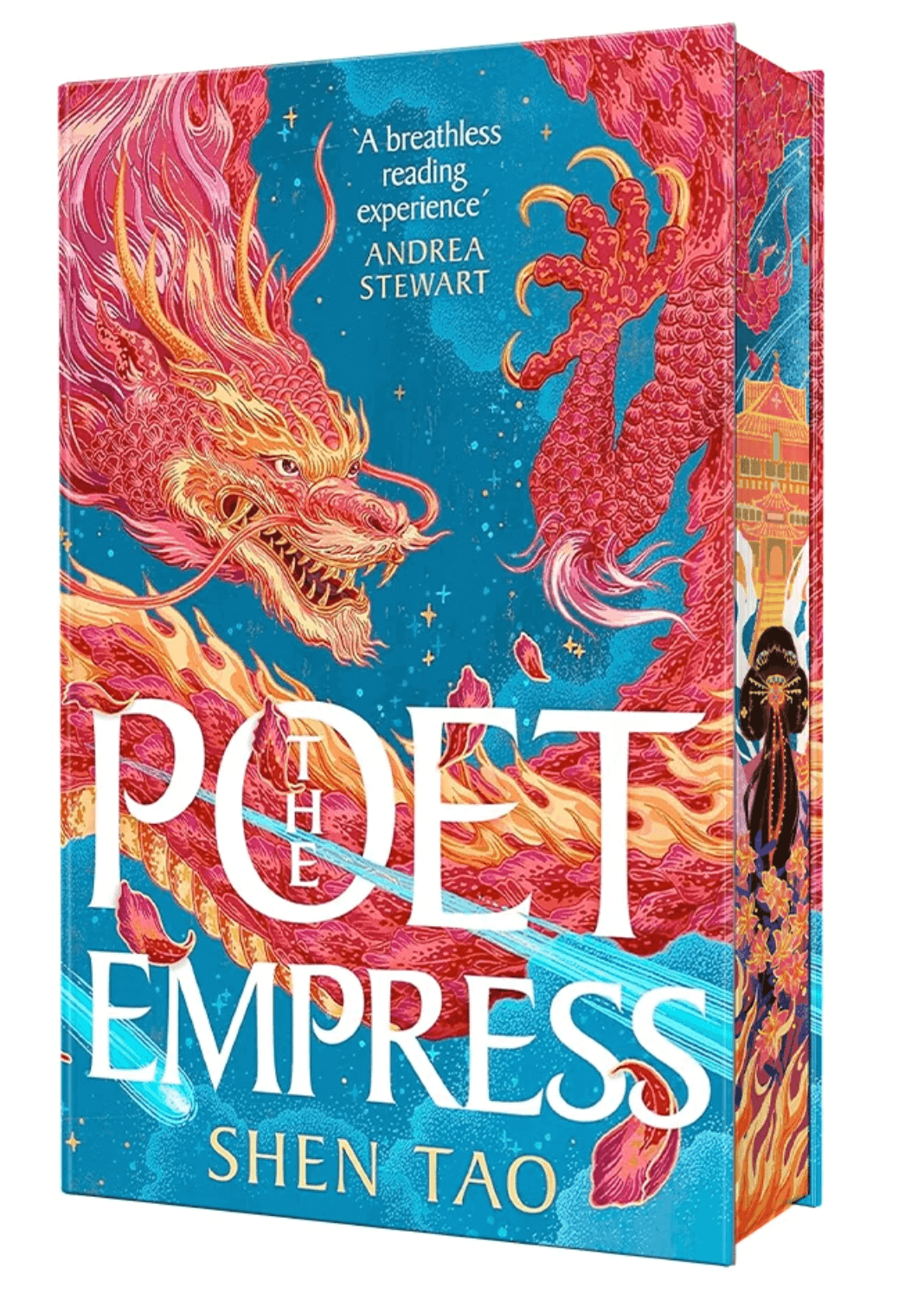
In about 400 pages, The Poet Empress introduces a famine-struck land, a dragon that must be conquered to claim the throne, magic written in poetry, a court of thirty rival concubines, and a succession war between two princes. Readers finish it feeling like they've lived in the Azalea Dynasty for years.
So how does The Poet Empress worldbuilding pull that off?
Mostly through strategic choices. Because what Tao put on the page, and just as important, what she left off it.
→ Catch up on the whole story in The Poet Empress Masterclass | How a Debut Became a Bestseller.
Welcome to the Azalea Dynasty
Here's the world in brief, spoiler-free.
The empire of Tensha is ruled by the House of the Azalea. Its heirs claim the throne by fighting a dragon, known as the Crown, into submission. The royal family holds magical gifts called Blessings, and poetry itself is a form of magic.
Outside the palace, the land is starving. Inside it, the emperor is dying, and his sons are locked in a war to replace him.
And in this world, women are forbidden to read.
That's the setting Wei Yin, a rice farmer's daughter, walks into when she offers herself as a concubine to the cruel heir to save her family.
Every piece of that world is specifically built to put pressure on Wei, and that's why it works so beautifully.
5 Worldbuilding Lessons from The Poet Empress
1. Start with something real, then give yourself permission to bend it.
Tao has said many of the classical poems she memorized as a child came from China's Tang Dynasty, an era when poetry flourished. The Azalea Dynasty draws loosely from that period.
The key word is loosely. She researched the era, then chose fantasy over strict historical accuracy.
→ Discover how her own history shaped the book in Who Is Shen Tao? | 9 Manuscripts, 10 Years, 1 Debut.
The Poet Empress is anchored in something real, and it changes what their story needed to change.
Why does that combination work so well? Because each half solves a different problem.
The real anchor gives you texture you'd never invent from scratch: how a court is ranked, what rituals fill a day, how power moves through a bureaucracy. Readers feel the weight of that history even if they couldn't name the era.
The bending gives you room. You can add a dragon. You can make poetry literal magic. (And nobody sends you letters about getting the emperors’ details wrong.)
But here's the most interesting change in The Poet Empress. The real Tang Dynasty had celebrated women poets, including Xue Tao. Tao's fictional dynasty forbids women to read at all.
Wei's entire story lives inside that one change.
Try this: Pick the real era, place, or culture closest to your world. List five true things you're keeping for texture. Then name the one thing you're deliberately changing, and ask whether your plot depends on it. If it doesn't, then it’s probably a superficial change that’ll lack the weight of The Poet Empress.
2. Make one rule of your world drive the plot.
In the Azalea Dynasty, poetry is power, and women aren't allowed to read.
Follow that chain and the plot almost writes itself.
Poetry is power, so literacy is access to power. Women are barred from literacy, so they're barred from power. Wei wants power over her own fate, so every lesson she takes is a crime.
The court's structure does the same kind of work. Thirty concubines compete for a single future empress's seat. Tao doesn't need to invent a villain for every chapter, because the system itself turns the women against each other.
Then Tao adds one more rule. The poem strong enough to kill the heir only works…if it's written with love.
→ See how that tension plays out in Loving Terren: The Poet Empress's Layered Villain. (coming soon!)
Margaret Atwood used a similar rule in The Handmaid's Tale. Women in Gilead are forbidden to read, so every scrap of written language becomes charged. A game of Scrabble turns into an act of rebellion.
That's the power of a rule that touches your protagonist directly. It turns ordinary actions into risks.
The common mistake authors make here is creating lore that never touches anyone. An elaborate calendar, a detailed religious history, a ten-page trade system…none of which ever affects a character’s life.
Try this: Write down the three biggest rules of your world. For each one, finish this sentence: "Because of this rule, my protagonist can't (or must) ___." If you can't fill in the blank, that rule is superfluous to the plot.
3. Keep the camera close.
Most of The Poet Empress happens inside the palace walls, seen through Wei's eyes.
Wei grew up in a rice-farming village. She doesn't know how the court works, who holds power, or which rules can get her killed. So the reader learns the world at the same pace she does.
That means Tao rarely has to stop and explain. Wei's confusion does the explaining for her.
It works even better because the stakes are high. In a court where one wrong move can be fatal, every rule Wei learns matters. The exposition arrives with danger attached, so it never reads like a lecture.
The wider empire doesn't disappear, either. The famine stays present because it's the reason Wei is in the palace at all. Her family is out there, and every choice she makes inside the walls is shadowed by them.
One reviewer described the effect perfectly: "your mind paints pictures anyway."
Suzanne Collins used the same device in The Hunger Games. We see the Capitol through Katniss, who finds it strange, excessive, and a little grotesque. Her outsider's eye does the worldbuilding and the social commentary at the same time.
The common mistake is the omniscient tour. The book opens with a sweep across continents, dynasties, and wars before the reader has anyone to care about.
If your point-of-view character has to learn the world, create a situation where your reader learns it with them, and skip the info dump.
Try this: Find a paragraph of pure exposition in your manuscript. Rewrite it as a moment where your point-of-view character makes a mistake and pays a price for it, or sees something about the world for the first time.
4. Let a few strange details do the heavy lifting.
Ask readers what they remember about the Azalea Dynasty, and you'll hear about the small, strange things. Horses with flowers for tails. Cats with holly leaves for fur. And of course, the dragon.
None of these details take up much space. But each one tells you this world runs on different rules than ours, and your imagination fills in the rest.
And Tao doesn't present them as spectacle. The horses aren't a set piece. They're simply what horses look like in Tensha. That matter-of-fact treatment is what makes them believable.
Try this: Brainstorm ten small details about ordinary life in your world: animals, food, weather, clothing, household objects. Circle the three most surprising. Use those, and keep the other seven in your notes. They'll still shape how you write, even if readers never see them.
5. Know what you're leaving out, and why.
Here's where it gets honest.
Not every reader loved how light Tao's worldbuilding is. One reviewer called it "a book about poetry magic that contains almost no actual poetry," and pointed out that the poem Wei spends the whole book writing never appears on the page. Another felt the magic system had no clear rules or limits.
Those readers aren't wrong. Poetry magic in The Poet Empress runs on emotion and consequence, not mechanics.
In craft terms, it's a soft magic system: we see what the magic costs, but not exactly how it works.
So does that make it a weakness? Mostly, no, and it's worth understanding why.
Brandon Sanderson has a well-known guideline for magic systems: the more a story uses magic to solve problems, the better readers need to understand how it works. Otherwise, the solution feels like a cheat.
Tao's central magic works the other way around. The heart-spirit poem doesn't solve Wei's problem. It creates her problem, because it demands that she love the man she wants to kill. We don't need to know the mechanics to feel that cost.
That's why the soft system mostly holds up.
Where it costs her is the book's central promise. The title is The Poet Empress. Readers who picked it up hoping to see poetry, and to watch Wei compose, noticed the gap.
Every standalone has to make this trade-off. There isn't room to show everything, so something gets left in the reader's imagination.
Every world has gaps. The skill is choosing the gaps your readers won't miss.
Try this: Write down the one thing your title, premise, or pitch promises. Then find the scene where the reader sees that promise fully on the page. If you can't find one, that's the next scene you need to write.
What Her Editors Focused On
Even a world this carefully built needed work in revision.
Tao has shared that her first full draft was a "throwaway" draft, written mainly to make the world and characters concrete. That's the draft where you're allowed to overbuild. The trimming comes later.
Then, when the manuscript reached her editors at Bramble and Gollancz, the edits focused on three things: clarifying worldbuilding details, living deeper in Wei's emotions in key scenes, and sharpening the pacing.
Look at the first item on that list. Her editors asked her to clarify the world, not to add to it.
When readers get lost in your world, reach for clarity before you reach for more lore.
Usually the fix is a clearer sentence at the right moment, not another page of history.
Questions to Ask About Your Own Standalone World
Before your next revision, run your world through these:
Which real place, era, or culture anchors your world, and where are you choosing to depart from it?
Which rule of your world makes your main character's goal harder to reach?
Does your point-of-view character have a reason to learn the world at the same pace as the reader?
Which three or four details will a reader still remember a month after finishing?
What does your title or premise promise, and does the reader get to see it fully on the page?
If you can answer all five, your world is doing its job.
The Dynasty Is More Than a Setting
There's one more layer to the Azalea Dynasty, and it's the one that turns good worldbuilding into great worldbuilding.
Look at the world's major systems side by side.
Literacy is forbidden to women, which keeps knowledge, and therefore power, in very few hands.
The throne is claimed by conquering a dragon, which means power is taken by force.
Thirty concubines compete for one empress's seat, which pits the powerless against each other.
And while the court fights over the throne, the villages starve.
Every one of those systems points in the same direction. Power in the Azalea Dynasty exists to protect itself, and someone else always pays the price.
That's why the world feels so coherent. Every system in Tao's world makes the same argument, and that argument is the book's theme.
When your world's systems all point toward the question your book is asking, your setting becomes part of the story's meaning.
Collins did this with Panem, too. The districts, the reaping, and the televised Games all exist to show how spectacle keeps people controlled. You could remove the romance from The Hunger Games and the book would still make its point. Remove the Games and it wouldn't.
The Azalea Dynasty goes one step further, because its victims include its own heirs. The same system that starves the villages also shapes the two princes at its center, long before Wei ever arrives.
→ We go deep on this in The Pain of Power: The Poet Empress's Broken Dynasty. (coming soon!)
Try this: List your world's major systems: government, magic, economy, religion, family structure. Next to each one, write who it benefits and who pays for it. If those answers line up with your book's central question, your world is working as hard as your plot. If they point in five different directions, you've found your next revision.
What This Means for Your Standalone

A real-world anchor, bent on purpose. One rule that drives the plot. A narrator who has to learn the world. A few unforgettable details. Systems that share a theme. Gaps you chose on purpose.
That's how Shen Tao fit an empire into one book.
Hemingway famously compared good writing to an iceberg: most of it sits below the surface, and readers feel its weight without seeing it.
Worldbuilding in a standalone works the same way.
You still need to build the whole iceberg. But the standalone writer has to be willing to leave more of it underwater.
A trilogy can explain. A standalone has to imply. Every detail that makes it onto the page needs to do at least two jobs: build the world and move the story, reveal a character, raise the stakes, or serve the theme.
And yes, that means cutting things you love. (I write dystopia, and my notes are basically a graveyard of systems and details nobody will ever read about.)
Those cuts aren't wasted. Readers won't see most of your world, but they'll feel it.
Does your author brand feel like your world?
Tao sets the mood of the Azalea Dynasty before she explains a single rule. Your typography can do the same for your author brand, telling readers what kind of stories you write before they read a word.
If You Liked This Article, You’ll Also Love…
When Water Whispers Danger: Create Authentic Fantasy Creatures by Studying Scottish Water Mythology
Magical Realism Done Right: How to Blend Reality and Myth Without Losing Your Reader
Wild Dark Shore Characters: A Deep Dive into the Salt Family & What Authors Can Learn
Mastering Atmosphere: Writing Lessons from Robert Louis Stevenson's "The Body Snatcher"
